Engineered Surfaces
What Is Cultured Marble? Properties, Uses, Pros and Cons
Cultured marble borrows marble's name but not its origin. It is a cast, coated product designed to imitate the look of marble at a lower cost.
Quick answer
Cultured marble is a manufactured product made from crushed limestone mixed with resin and coated with a gel finish. It is not natural marble, even though it is named after it.
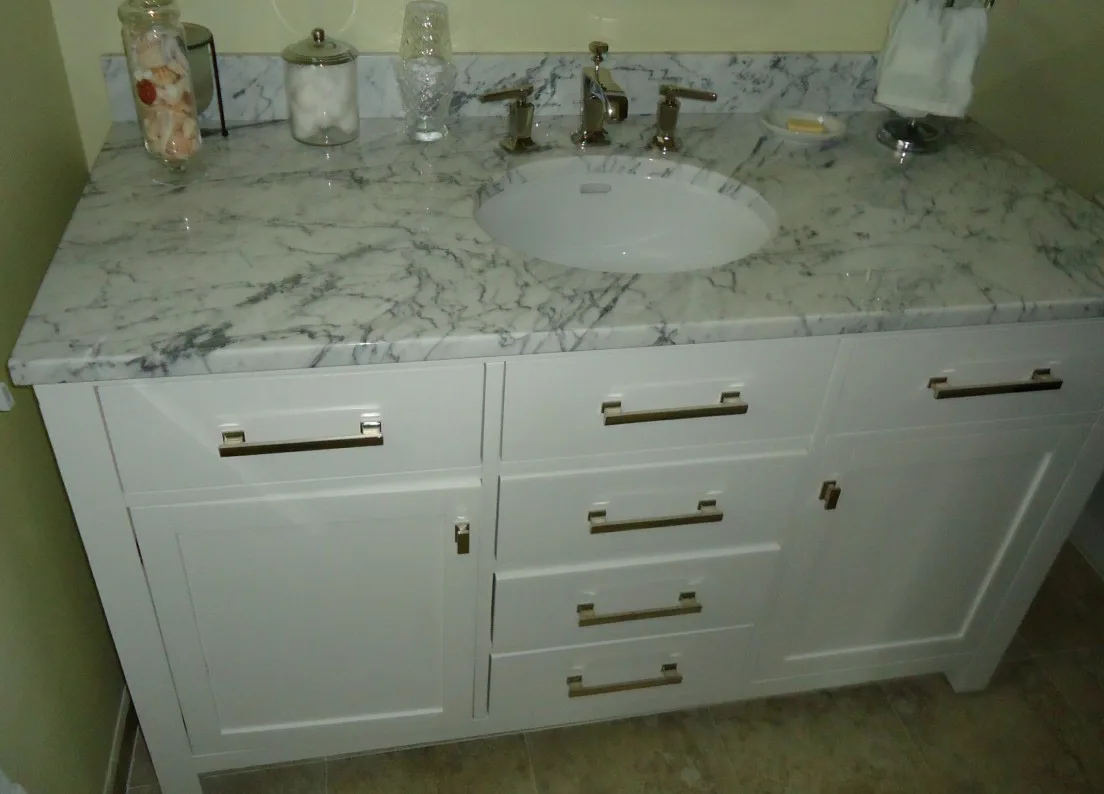
Cultured marble is a manufactured product made from crushed limestone mixed with resin and coated with a glossy gel finish. Despite its name, it is not natural marble.
What Is It Made From?
Cultured marble combines crushed limestone (or a similar mineral filler) with polyester resin. A pigmented gel coat is applied to the mold surface before the mixture is cast, which produces the glossy, colored finish.
How Is It Manufactured?
The resin and crushed stone are mixed and poured into molds — often for vanity tops, sinks, and tub surrounds — with the gel coat forming the visible surface. Once cured, the pieces are trimmed and polished. The process allows sinks and tops to be cast as single, integrated pieces.
What Does It Look Like?
Cultured marble typically has a uniform, glossy surface, often in whites and creams with a marbled or solid appearance. It imitates marble's look at a lower cost, but its even, molded finish lacks the depth and variation of real stone.
Where Is It Used?
Cultured marble is most common in bathrooms — vanity tops, integrated sinks, and tub and shower surrounds. It is less common in kitchens, where heat and harder wear would damage the gel coat more quickly.
Care and Maintenance
Cultured marble is non-porous and does not require sealing, but its gel coat is sensitive: abrasive cleaners scratch it, and strong chemicals or dyes can stain it. Hot tools and very hot water can damage the surface, so heat should be kept away from the gel coat. Cleaning should use mild, non-abrasive products.
Advantages
- Lower cost than natural marble.
- Integrated sinks and seamless vanity tops.
- Non-porous surface with no sealing required.
- Wide availability in standard sizes.
Limitations
- Gel coat scratches and can be damaged by heat.
- Can stain from strong dyes and chemicals.
- Lacks the depth of real marble.
- Harder to repair invisibly than solid surface.
Common Misunderstandings
Cultured marble is not marble — it is a cast, coated composite that borrows the name. Its non-porous surface does not make it heat-resistant or scratch-proof, and it should not be maintained like natural stone. For real marble's look and properties, choose natural marble — and expect its different, higher-maintenance behavior.
References & further reading
- Cultured marble — Wikipedia
- Solid Surface & Cultured Stone — International Surface Fabricators Association